
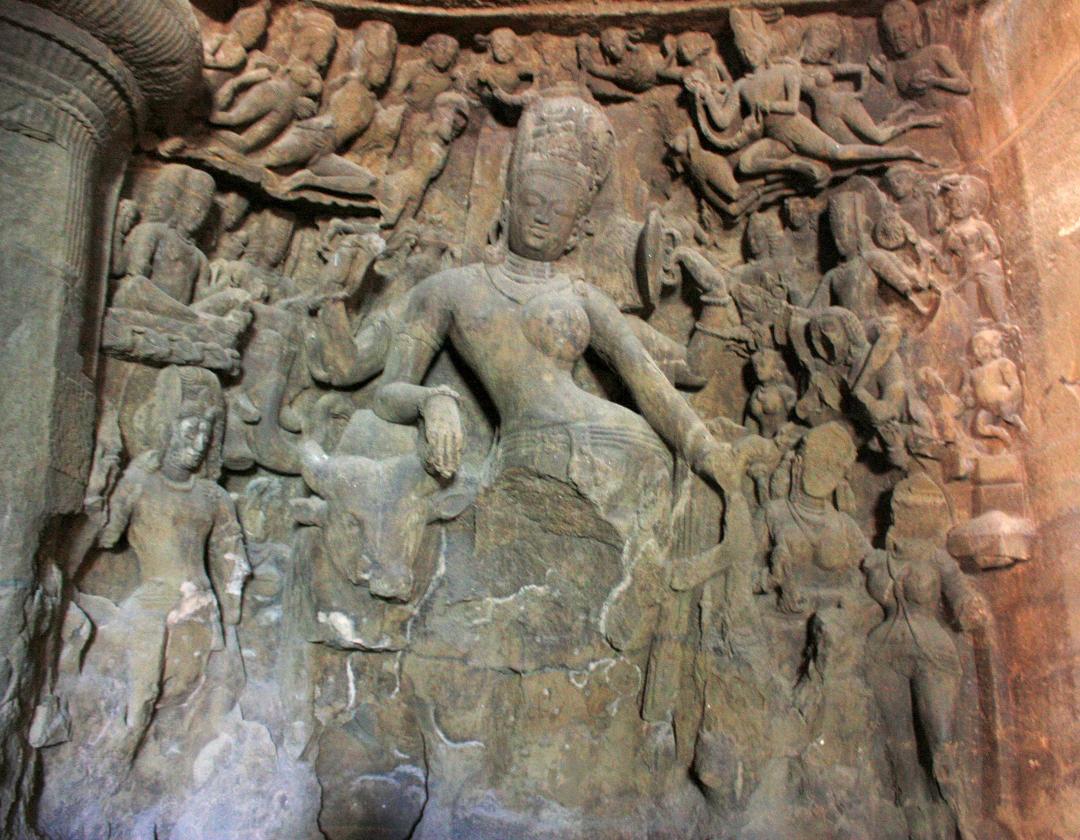
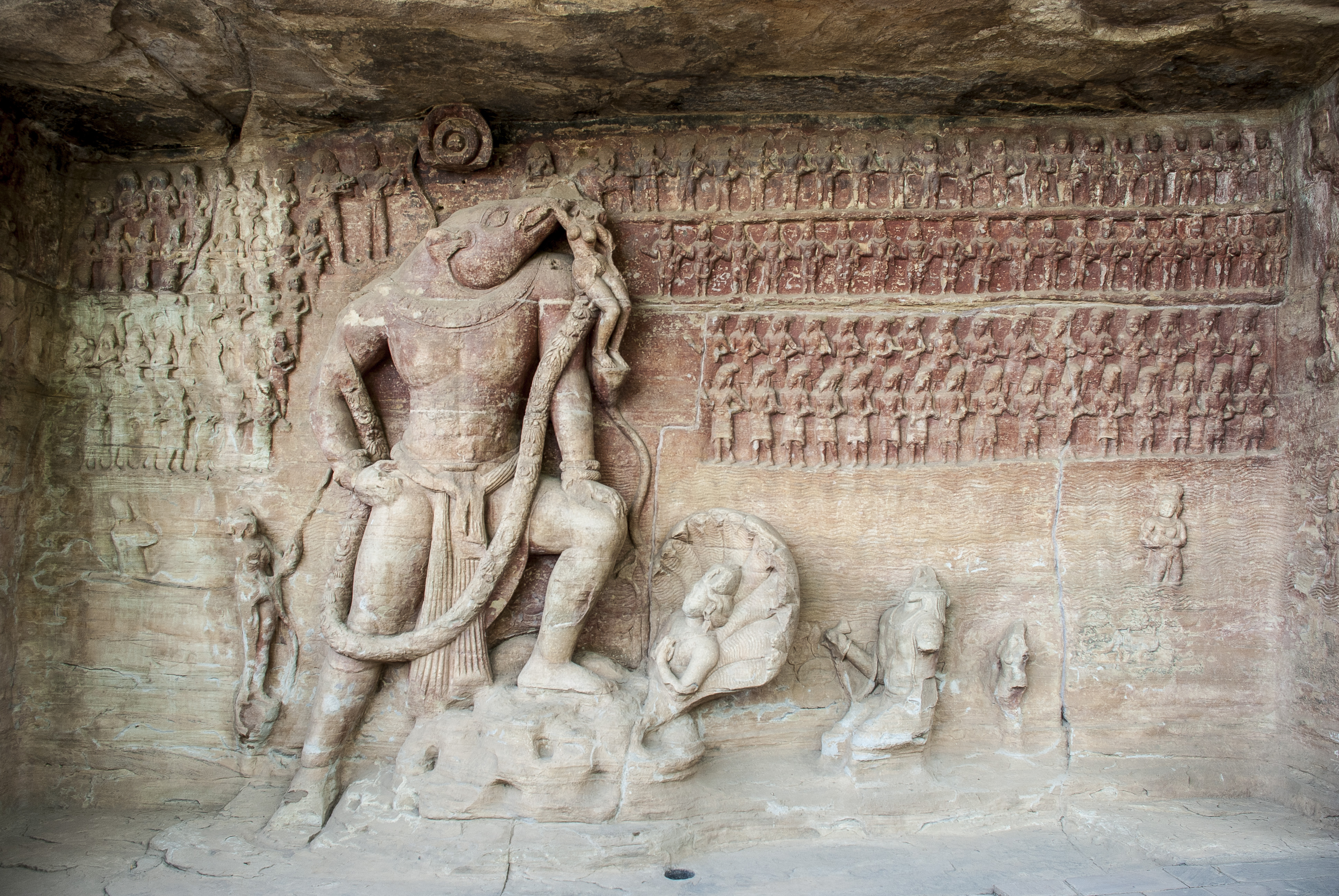
Peering into my computer screen, my eyes scan the images searching for similarities. Varaha, the boar-headed avatar of Vishnu, stands in strength towering over Shesha. Likewise, Ardanhari is much larger in scale than the remainder of the objects in the panel. Both Ardanhari and Varaha are the focal point of the image. Despite being the main attraction the relationship between their surroundings relay a deeper significance. Surrounded by carvings of smaller figures both Ardanhari and Varaha are presented larger than life and supreme over the other gods. As Varaha stiffens his body into a commanding stance firmly gripping Shesha beneath his feet, it’s evident who holds the authoritative power. Shesha becomes a prop to exalt the position and power of Varaha. Ardanhari also utilizes an animal, which is Nandi. In contrast the authoritative position being exercised over Shesha, Nandi appears to be in partnership with Ardanhari. Nandi performs as a support for Ardanhari. Ardanhari’s stance is relaxed, draping his/her elongated arm across her hip, while resting their upper body weight on Nandi. Ardanhari and Varaha are similar in that both main subjects have their body weight resting predominately on one side of the body. There are also some similarities, in the ways in which Varaha and Ardanhari position their body weight on two different types of animals. However, the message being conveyed through the visual relationship to the animals is entirely different.
The numerous figures behind Varaha are presented in an orderly manner and the spatial differences remain uniform throughout the composition. This supports the idea that Varaha is a leading commander who exercises his power and authority over Shesha. The figures behind Varaha are lined up as an army of less powerful subordinates who are ready to take orders from Varaha, their commanding officer. Great! It’s apparent by how the smaller figures are positioned, in addition to their much smaller scale, that they are ready to receive instructions from Varaha.
In contrast to the uniformity pictured in the Varaha image, the multitudes of figures surrounding Ardanhari embody the posture of worship or reverence. The miniature gods are preoccupied with the needs and desires of Ardanhari. In contrast to the structured army behind Varaha, there seems to be unremarkable order in the surroundings of Ardanhari. Each figure behind Ardanhari seems to have a task to perform, which is paying homage to or bearing witness to the power of Ardanhari. The tranquility of Ardanhari is evident in the relaxed position of the body. Although the smaller figures are less visually organized its evident they are serving their subordinate to the central figure.
Despite the differences between the images of the Ardanhari and Varaha, there are distinguished similarities. The images seem to convey an opposite spectrum of ideas and actions, but the symbolism used was similar.

 Art of South Asia Project
Thank you so much Michelle for explaining the similarities and differences of these works. At first glance when looking at them I thought these were two completely different pieces of work that were in no way similar. I figured one was about animals and the other was about people. It wasn’t until reading what you had to say did I realize the similarities are found in the things that are not evident. The large size of the centered characters do portray the power they hold within the scene yet the positions they take give off different ways as to how these characters showcase their power and authority. Also, the smaller characters themselves give the impression that they are looking up to these larger character. However, in Varaha’s scene they seem to not have any individuality which supports the idea that Varaha implements his power a certain way. Yet in the scene with Ardanhari the smaller characters seem to have individuality and are choosing to look up to Ardanhari because they admire him, not because he/she positions themselves as a strict ruler.
LikeLike