
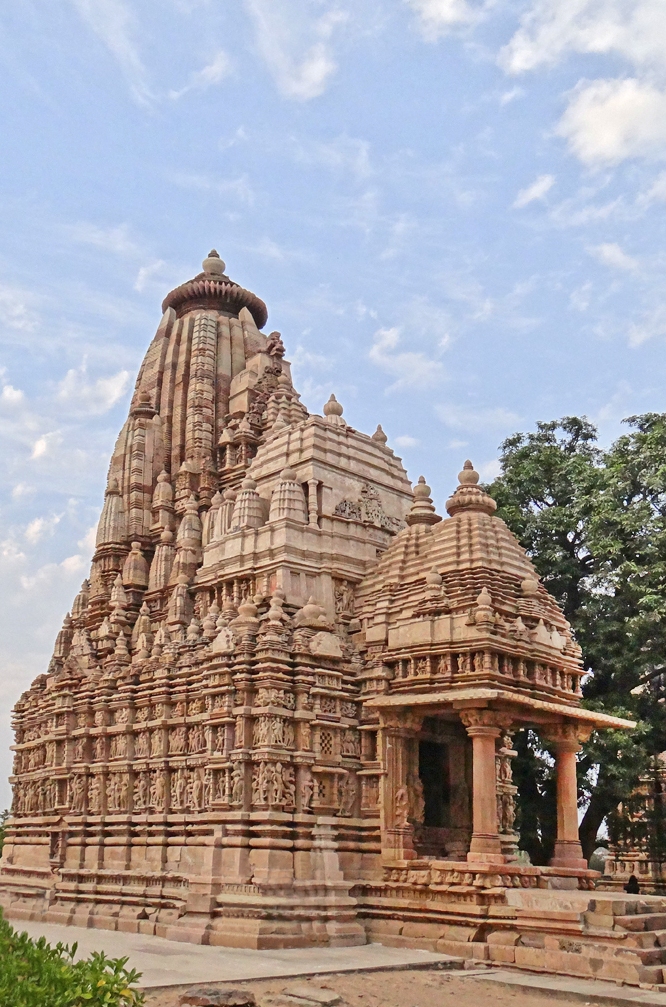
10th century or 955 CE. Madhya Pradesh, India. Parsvanatha.
Here we have a 10th century Jain temple that is believed to have been constructed in 955 CE. This temple is dedicated to the 23rd, of 24, tirthankaras, Parsvanatha which is why this is known as the Parsvanatha Temple at Khajuraho. This temple is located in Madhya Pradesh, India. I want to acknowledge the fact that this is believed to be the earliest Jain temple yet it is full of detail and really gets the attention of the viewer due to the precision of the art on the shikara and vVimana. A shikara is the part of the sculpture that looks like a rising tower as the word translates to mountain peak. Above the shikara is an amalaka which resembles a donut. The amalaka is specific to Northern style temples only as Southern temples do not have this structure. This sanctum of this structure consists of several parts which really gives the temple that tower look. Surrounding the aedicules which are the smaller shikhara and gavaksha’s as small shrines on the vimana walls. The vimana is the part of the temple that houses the shrines. This particular temple has shrines dedicated to Parsvanatha. There are several sculptures of him sitting with his legs crossed as if he is meditating. The vimana on the structures are normally extremely detailed on the exterior as the vimana on this temple pays homage to the gods and goddesses of both Hinduism and Jainism. There is a crossed legged Apsara, the couple of Vishnu and Lakshmi, Surasundari, Kama and Rati, and many more. Another part of this temple is the mandapa which is considered to be the gathering hall or the porch of the temple. This is an open area on the outside of the temple that is bordered off by these beautiful columns. The ceiling of the mandapa would be considered flat surface with several levels as there were only three styles. The other two are those carved on single levels and those that were created in vaulted fashions. The temple looks as if there are three levels to if when looking at it from the side. First there is the mandapa, then the vimana and lastly another vimana that has the shikara above. Overall, this is a very beautiful temple and there obviously was a lot of focus and determination put into this piece of art just by the tremendous amount of detail.

 Art of South Asia Project
I love how you described the shikara! Your description of the shikara was well articulated by your writing to reflect the height of the shikara. Awesome! I enjoyed reading your blogpost and found your style of speech to be helpful in furthering my understanding. Prior to reading your blogpost, I often found myself confused when trying to differentiate the northern vs southern style. I enjoyed reading your description of the mandapas. The mandapas are my favorite area of the temple and I like how the word sounds. I spend the majority of my time outside on my porch and the screened porch of my house is the main gathering area, which is probably why I am drawn to the mandapas. Great job!
LikeLiked by 1 person