
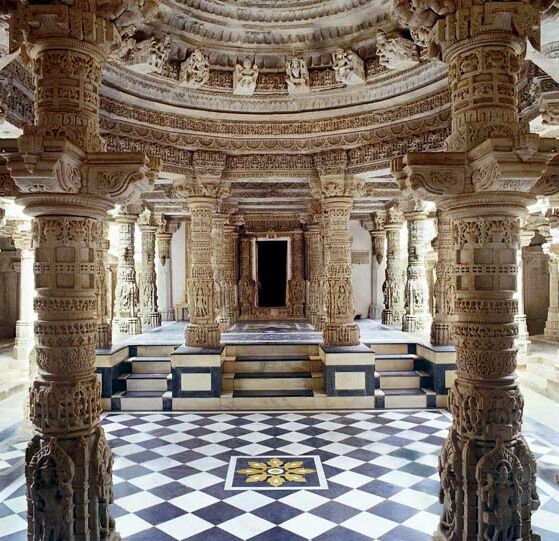
When entering the Dilwara Temples in Mount Abu, India, one is taken back with gasps as they absorb the grandeur. Among the massive slabs of marble are delicate intricacies that have been molded and carved to perfection. Towering above the winding roads and elevated hills in the Aravalli Range in western India, one will find the Vimala Vasahi Temple. Vimala Vasahi Temple is the oldest of the five Jain temples. The Vimala Vasahi Temple was constructed by Vimal Shah and designed by Vastupala-Tejpal, both of whom were Jain ministers of Dholka. In 1021 AD, the Vimal Vasahi Temple was erected. The Jain ministers were renowned for their ability to design and create masterpieces from the dense stone. After construction, the Vimala Vasahi Temple was dedicated to lord Adinatha, who was the first Jain Tirthankara. The site of the Dilwara temples is considered a sacred pilgrimage destination by practicing Jains.
Jain temples are constructed in a square plane and allow for an opening on each of the four cardinal directions; north, south, east and west. In each direction, there is a clearance making a pathway that leads to the display of one of the Tirthankaras. In contrast to the typical Jain temples, the Dilwara temple-city as a whole and specifically the Vimal Vasahi temple doesn’t have a typical nagara style and is without the renowned shikhara. Despite lacking the shikhara the temple is opulent yet restrained in the interior.
Throughout the temple ceilings, detailed murals silently speak while depicting mythological scenes. Lotus-buds, petals, and flowers blanket the ceiling of the temple. Carving within the white marble into points on the central ceiling depict the picture of a lotus flower that also mirrors a spiral seashell. The colonnade positioned alongside the main mandapa of the temple highlights the open space of the temple meeting area. Large columns throughout the temple create order and structure among the intense details. Carved within the columns of the temple are women playing musical instruments along with 16 mantra goddesses, also known as Vidyadevis, each holding their own symbol. Its uniform structures breathe simplicity while engaging the visual perceptions in great magnitude. Swirls of marble are carved to a sloping perfection and look as though they were molded rather than carved. Despite the flooring not being part of the original design, the black and white checkerboard floor symbolizes duality, which is a common theme among the religions of this region.

 Art of South Asia Project
This is absolutely amazing! I love how you were able to tackle such an intensely detailed piece of artwork and give such accurate details and supportive information to better describe what is being portrayed in this work. I also appreciate your perspective on the reasoning of the columns. They do in fact create structure and order throughout the temple which is the perfect way I believe to offset the details of the immense interior. Lastly, I want to give you acknowledgement on giving meaning to the newly added flooring of the temple. I would never have thought to think of why black and white squares other than the fact that it is beautiful not thinking at all that is symbolizes duality. Great job Michelle!
LikeLike