
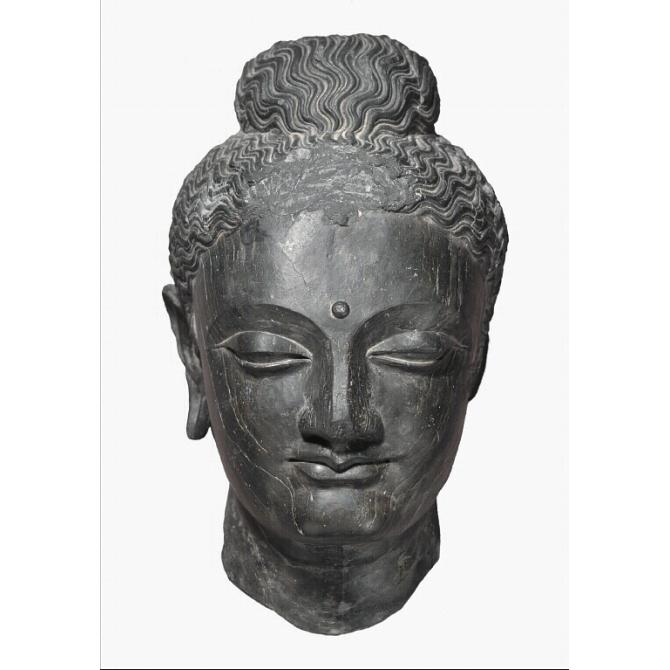
Place of Origin: Pakistan, Peshawar valley, ancient region of Gandhara
Date: approx. 300-500
This sculpture of Buddha was discovered in Pakistan, specifically in the Peshawar valley, which is an ancient region of Gandhara, in approximately 300-500.
Upon first glance of the sculpture called The Head of a Buddha, I’m immediately drawn to the smooth texture of the stone, specifically schist. Schist is comprised of quartz, having a solid texture and smooth density. Low-intensity hues of dark green set in a black overtone appear to be the color of the sculpture but it’s unclear if that was the original color. Its shape and form is three dimensional and the space centered around the pursed out lips and wide nose make them stand out among the features of the sculpture.
Intricate detail lines the Buddha’s head. The artist uses white creases to add depth and texture to his hair. I think the type of stone used and the smooth surface may be an indication this is a revered man of leadership. The pose is unclear because it’s lacking a body but his face seems peaceful. This relaxed expression alludes to the likelihood his entire body is relaxed. It’s interesting to note the peaceful rest that emanates from the sculpture and that the Noble Eightfold Path is also filled with peace-keeping elements.
The large right ear seems to create an imbalance of weight and the head emerges from a ball of stone going upward. The technique of polishing the stone give hints of nobility of the Buddha. The sculptor’s carving of the stone is evident by the distinct line around the nose and eyes and the grooves within the hair. It appears the pedestal or base is built into the sculpture piece and isn’t added, but I’m not sure because I’m looking at a picture. The sculpture can be enjoyed from different perspectives from at least three differing views, although directly across would be my suggested favorite. If you only experienced one side at a time, for example a profile image, the large scale of the right ear wouldn’t be noticed to the degree it would be from the front.
I’m impacted by the scale of the ear and feel urged to research if that has a particular meaning or is it just a coincidence. It’s fascinating that a multitude of similar sculptures were made around the world at different periods of time and many look nearly identical.

 Art of South Asia Project
I love how you are able to break the sculpture down into sections and are able to analyze the portions in such detail. You explain the depth of the ridges and the smoothness of his face. You state how it makes you feel as if he is at peace. The white lines in his hair is interesting to me because I didn’t give it much thought when I first looked at the picture. I remember being little and hearing the women in my family complain about white hairs however my grandmother always said it symbolizes wisdom. Seeing these white hairs on the Buddha really justifies that for me because he lived and breathed the Eight-Fold path.
LikeLiked by 1 person
I like how you understand the details of the sculpture and understand the meaning of the details. Each symbolic detail has a meaning that represents the presence of the Buddha. Even though the sculpture does not have a physical body that is attached to the head, you still explained why and how it is the Buddha. Probably for most people, they have only seen sculptures of Buddha with mudras, such as myself. Mudras has a great symbolic meaning and signifies the presence of the Buddha, and I like how you used imagery to signify that if the sculpture had a body then the body would be relaxed.
LikeLiked by 1 person