
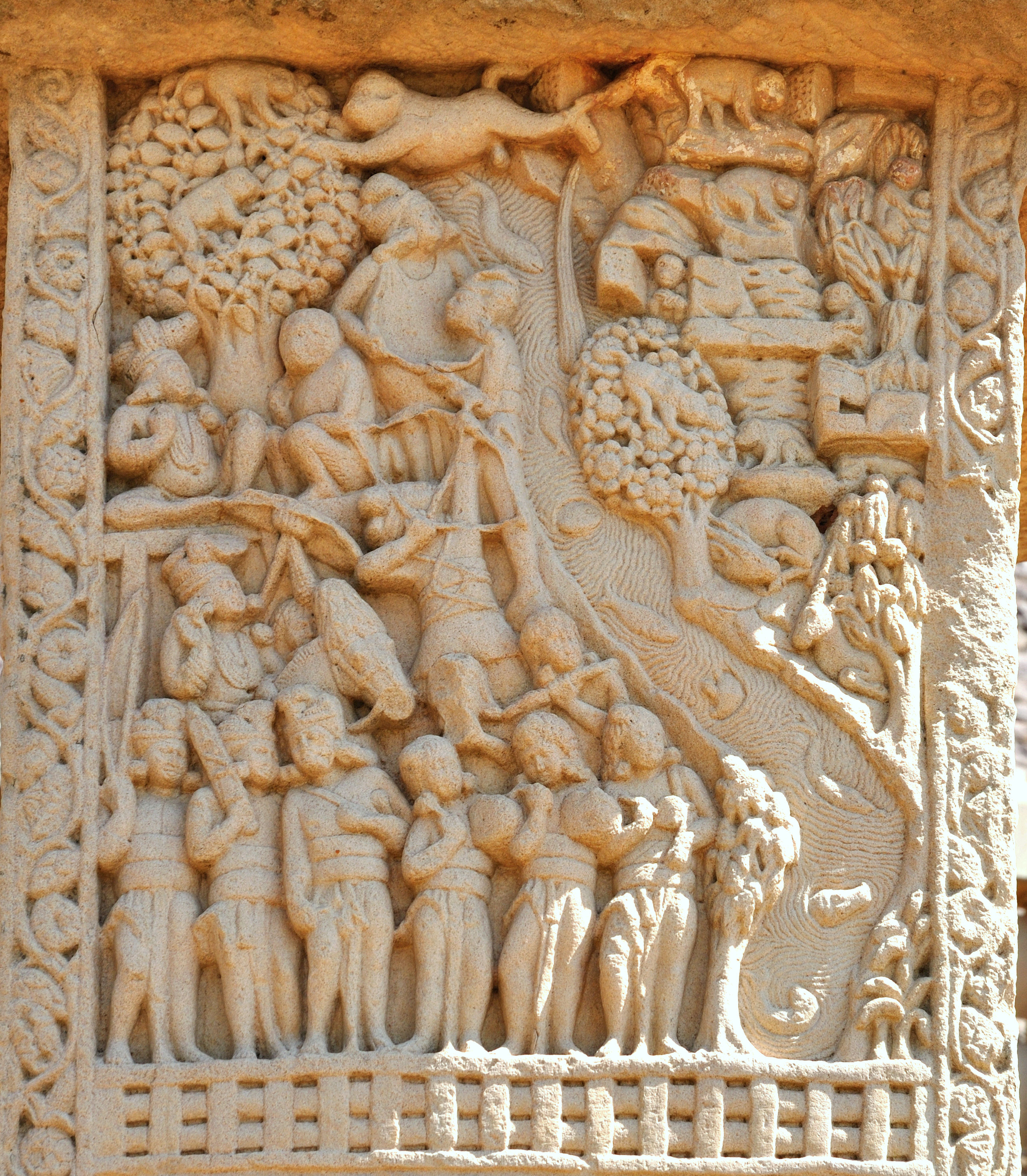
Sanchi Stupa 1, western gateway (torana), ca. 100 BCE-100CE
In the Sanchi Relief piece entitled The Great Monkey jataka, there is a lot going on within the condensed square, with marked organization. The outer edge of the square image resembles a picture frame that adds a sense of community, as I peer through a window into another realm. Incised lines throughout the piece contribute to the organization and the definition that is within the image. As I study the various objects I can almost feel the texture created by the artist on the tips of my fingers. Depth is added to the flowing river by the artist incorporating rigid lines for the waves of the water. The leaves of the tree are chiseled to perfection giving each leaf definition.
A particular monkey just above the tree standing to my right is smoother than the others, which may have been intentional or corrosion, but either way it stimulates my senses and I can imagine my fingertips gliding across the smooth material. I’m noticeably relaxed focusing on the monkey and the rigid waves of water. The short vertical and horizontal strips framing the bottom resemble the weaving of homemade apple pie crust, which bring further comfort to my senses.
A crowded group of people at the bottom left bring balance to the freedom I feel occurring on the right portion of the image. Incorporating the use of natural elements such as the large stones and the monkeys sitting on the ledges of cliffs enhances the feeling of freedom and liberty. The scenic view is cultivated by the stones on the right portion of the jataka filled with animals, water, and trees. The placement of these objects directly correlates to the immense liberty that we see emerging from the right side of the image. Nature is renowned as a therapeutic environment. Focusing on the right portion I similarly feel as one would after walking outside during a crisp spring day, after spending hours in the confines of an office. The artist places most of the animals in the upper portion of the image, while the people are mostly anchored on the bottom with a few exceptions. The scarcity of people in the right portion opens up the space and it’s free from the overlapping of people as compared to the left portion. In the river its evident there are fish, but one figure I’m not certain of its identity; I suggest it’s possibly a pig.
At first the mood of the image seems to be jovial with people interacting with monkeys and one another. One of the king’s soldiers aims a bow and arrow toward the monkey-king, who has stretched his body across the river in a selfless attempt to help the other monkeys escape to safety. Although he is hidden within the intricate detail he holds a key position and what he is doing has an impact on the perceived mood of the image. The scene changes completely and is more hostile than I originally thought and brings on feelings of confusion and uncertainty.
Finally, the animals and the people have distinct expressions on their faces and I can sense their personalities while gazing at the image. The monkey positioned at the very top right looks mischievous and is likely the rival monkey that injured the monkey-king in an attempt to flee over the river. It appears to be the same mischievous monkey at different altitudes standing on the cliffs. The placement of the same monkey at different heights signals motion occurring. In the midst of running, he desires to turn around and see if he is being pursued by the others. The monkey’s body is tensed and not relaxed as some of the other monkeys who are peaceful and resting on the boulders. Lastly, the mischievous monkey could also be sneaking up on the monkey to the very right of him. The monkey on the far right seems to be surprised and protecting something he is holding in his hands.
Overall the image is detailed and condensed, yet is organized into sections with the river creating balance. The soldiers in the king’s army anchor a sense of weight, that contrasts with the liberty and lightness that the artist expresses on the right portion of the image.

 Art of South Asia Project
Naturally, I looked at the picture before reading your blog post about it. Prior to reading I was trying to find a starting place as there is a lot going on in this picture. I was able to come to terms that the humans and the monkeys were coexisting in this space. Once I read your thought, the entire picture instantly made more sense to me. Thank you so much for breaking the picture down. From the left to right of the river and going even more in depth by describing what is happen at the top and bottom on both he left and the right side. And the emotions that you came to are the same I had at first glance. Great job on the Monkey Jataka!
LikeLike
Prior to reading about the Sanchi Stupa Sanchi Stupa 1, western gateway (torana), ca. 100 BCE-100CE, I did not know where to begin to try to understand the piece of art. At the time I thought that the people were just trying to inherit land that wasn’t there’s, but I realized it is deeper than that. I like the detail you re3alized about the monkey’s and revealed the true identity of one monkey. You have used your imagery to connect with the past and pulled out each individual story. You identified each story and connected them to the “big” story. As I watch for the monkey’s trying to escape, I can feel that fear they felt towards the human-beings. And with the King Monkey showing great courage, saving his people, shows a great deal of sacrifice that a person will go through in order not to look selfish even if they are in power.
LikeLike